
SPF and DMARC in the Tranco Top 100,000: Our October 2026 DNS Snapshot



We analyzed the DNS of 99,441 domains from the Tranco top 100,000: 60.2% published a DMARC record and 21.7% published p=reject. Among the 72,645 with a non-null MX record, 91.5% published SPF, 76.0% published DMARC, and 47.9% published a reject or quarantine policy.
- 91.5% publish SPF (of 72,645 domains with a non-null MX)
- 76.0% publish a DMARC record (same base; any record, misplaced or malformed included)
- 47.9% publish
p=rejectorp=quarantine(same base) - 2.9% of SPF records exceed 10 DNS lookups (of 70,338 single SPF records, for a sender the record doesn't list)
- 21.2% of DMARC records have no
ruaaddress (of 59,896 domains with a DMARC record) - 16.3% of BIMI certificates had expired (of 2,655 certificates we retrieved)
What this measures: the DNS configuration these domains published on 27 October 2026. We didn't send or receive mail, so the scan says nothing about delivery outcomes, which identities real mail uses, or whether anyone receives and reads DMARC reports. DMARKOFF builds DMARC monitoring tools and appears in the data as the reporting address of six domains.
Key findings
- Less popular domains are less likely to enforce DMARC. Among domains with a non-null MX, 74.3% of the top 1,000 publish
rejectorquarantine; between ranks 10,001 and 100,000, 46.5% do, and 24.8% publish no DMARC record. - SPF complexity looks the same at every rank. Between 2.5% and 2.9% of SPF records in each rank group need more than 10 lookups for a sender they don't list, and another 7.5% overall need 9 or 10.
- Records without a reporting address lean toward
p=none. 57.0% of the 12,672 DMARC records withoutruausep=none, against 29.5% of records with one. - Among domains with at least one SPF record, SPF errors were less common where the DMARC record lists a vendor reporting address: 5.0%, against 6.4% where all
ruaaddresses are on the domain's own organizational domain and 7.4% with DMARC but norua. The gap remains within the two larger rank groups.
The domains we analyzed
We split the 99,441 analyzed domains by their MX records. 72,645 published at least one non-null MX record, and we use this group for the headline adoption rates. It's a subset defined by DNS, not a verified list of sending domains: a domain can send mail without an MX record, and an MX record doesn't prove that it sends any. A null MX (RFC 7505) is how a domain says it accepts no mail.
Rank groups are ranks 1 to 1,000, 1,001 to 10,000, and 10,001 to 100,000. Where a figure uses a different base, its caption says so.
SPF: the 10-lookup limit
A receiver may resolve at most 10 DNS-querying terms while it evaluates an SPF record, nested includes counted (RFC 7208, section 4.6.4). Evaluation stops at the first mechanism that matches the sender, so the count depends on who is sending.
We counted the lookups for a sender the record doesn't list: the documentation address 192.0.2.1 with the envelope sender postmaster@ plus the domain. We use these placeholder inputs to expand the whole SPF dependency chain, nested includes included, and a redirect where one applies; a redirect is ignored when the record has an all term. The count can continue past a point where a real evaluation would stop. Sender- or IP-dependent macros are expanded with those values, so for the 2,844 single records that use them in their own terms, the count reflects these placeholder inputs. These are counts from the checker's model, not measurements of the DNS queries made for every real message.
A sender matched by an earlier term can pass before the limit is reached. The counts are estimates from our checker's evaluation model; the median record needs 3 lookups.
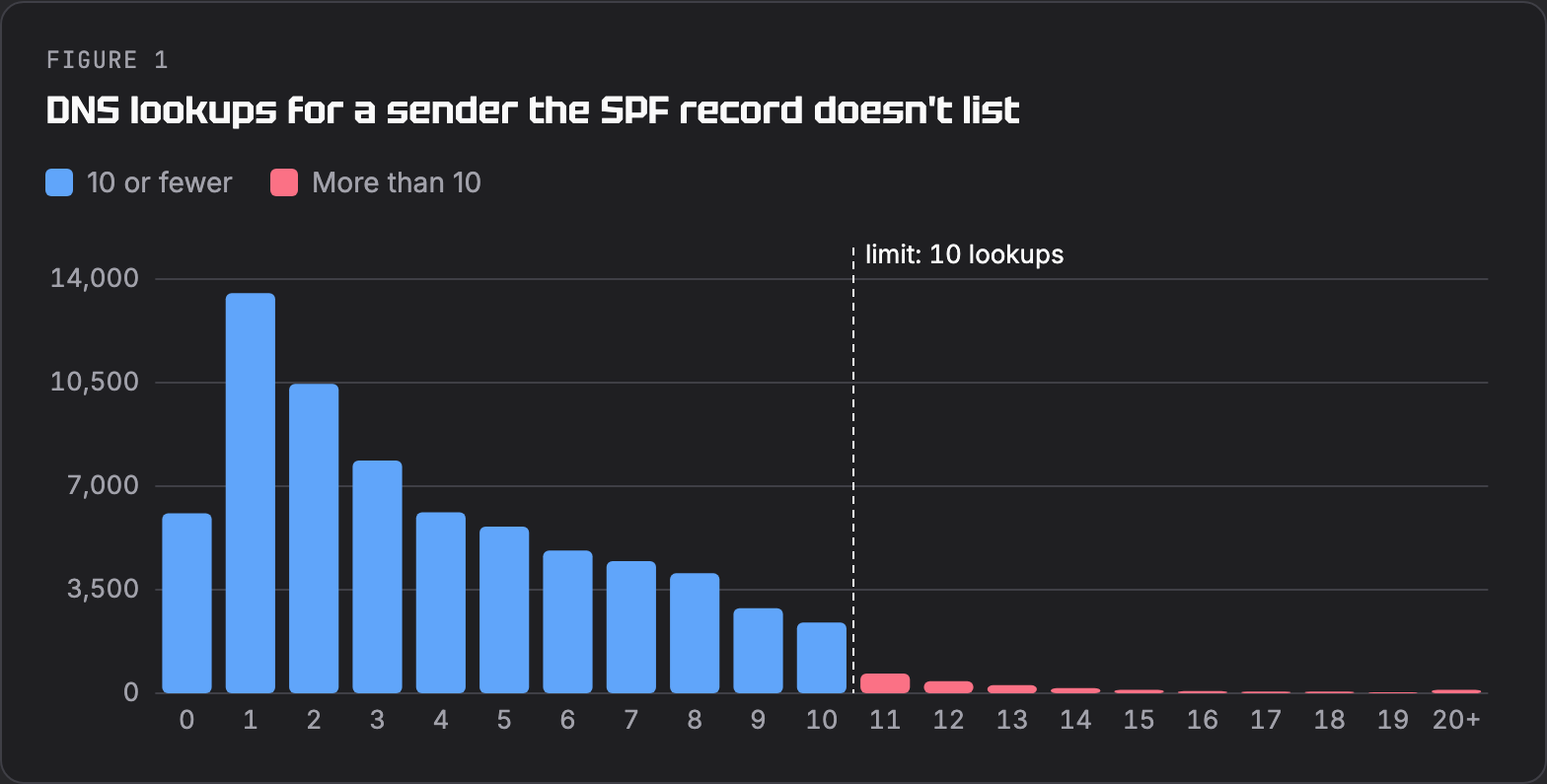
70,338 analyzed domains with exactly one SPF record. Counts continue past 10 to show how far over a record is; a receiver stops at the 11th lookup. The last bar is 20 or more. 2,011 records (2.9%) exceed 10; 5,270 (7.5%) need 9 or 10.
The share over the limit was similar across rank groups: 2.8% of the 753 records in the top 1,000, 2.5% of 6,712 in ranks 1,001 to 10,000, and 2.9% of 62,873 further down.
What a receiver does with such a record is another question. In our test of 21 mailbox providers, Gmail and Yahoo returned spf=pass for the 11-lookup test record, while Microsoft and Apple refused those messages. SPF permerror doesn't settle the DMARC result either: a message can still pass DMARC with an aligned DKIM signature.
What popular includes cost
Most widely used includes cost one lookup. A few cost far more. The cost below counts the include term itself plus everything it pulls in, as published on 27 October 2026.
In this snapshot, an include of Yandex or QQ Mail costs eight lookups. Add Google Workspace's one-lookup include, and one lookup is left for everything else. Another service may need more than that, so count its full nested chain before adding it.
Why SPF records fail
Among the 71,117 analyzed domains with at least one SPF record, the checker flagged SPF permerror on 4,241 (6.0%). The most common failed check was the lookup limit, followed by an include or redirect whose target doesn't resolve, and by two or more SPF records on one domain.
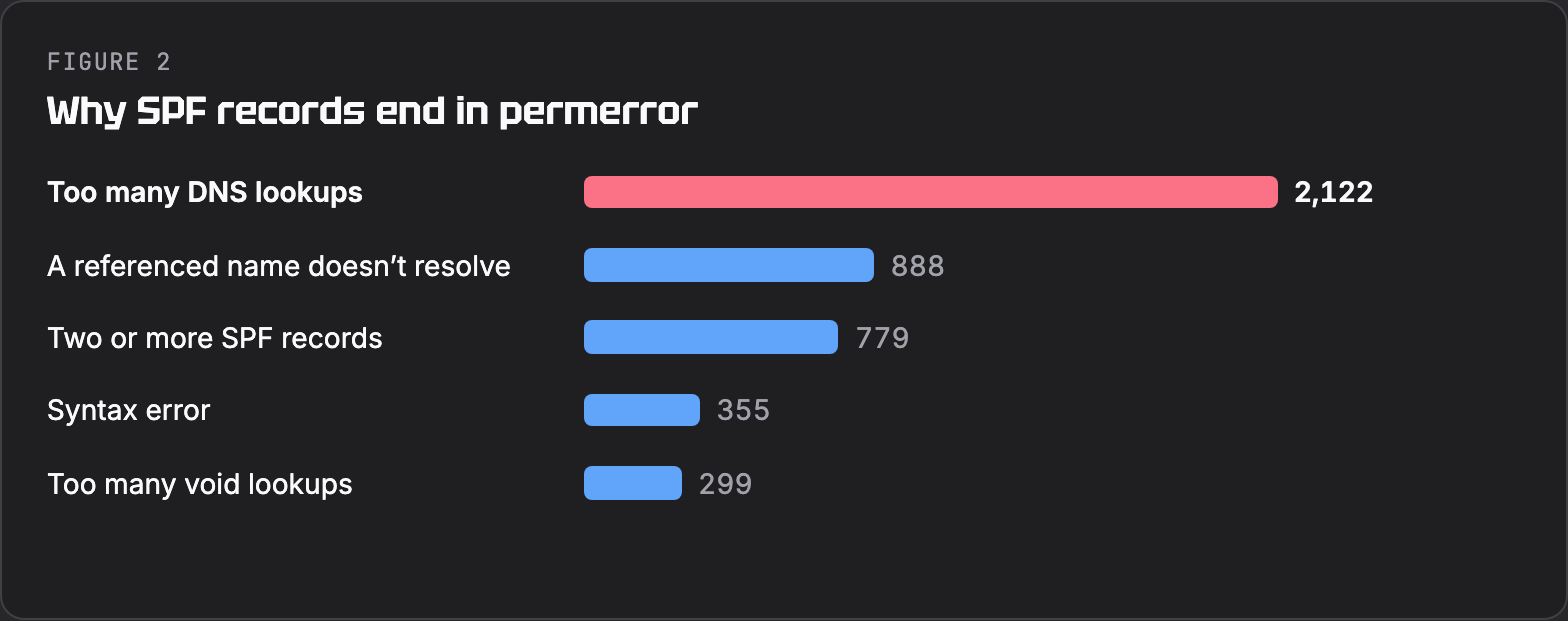
The 4,241 analyzed domains with SPF permerror, by the check that failed. A domain can fail more than one, so the bars add up to more. "A referenced name doesn't resolve" is an include or redirect whose target has no SPF record or doesn't exist. The lookup-limit bar counts 2,122 domains, more than the 2,011 in Figure 1: 111 single records with 10 or fewer counted lookups fail the same check, for example through an include that loops back to the record itself.
Half the records end in ~all (softfail) and 45.1% in -all (fail). 1,489 end in ?all, which returns neutral, and 35 end in +all, which makes every IP address pass SPF for the domain. 1,897 records have no all term, which isn't an error by itself: 1,587 of them end in a redirect, and the other 310 return neutral for a sender that matches nothing.
Includes that point nowhere
About 460 domains include, or redirect to, a name that doesn't exist (NXDOMAIN). We classified each name by the registrable domain behind it. For most, the registrable domain exists and only the name under it is missing. 36 aren't host names at all, such as two includes run together without a space, and 15 sit under a top-level domain that doesn't exist.
16 domains include a name whose registrable domain doesn't resolve. If such a domain is free, whoever registers it can publish SPF that authorizes their own servers for the domain that includes it. We checked these 14 registrable domains with RDAP and WHOIS on 28 October 2026. Nine were registered but not resolving, reserved by the registry, or in zones the public can't register in. Two had no registration in the registry's WHOIS, one was in its redemption period, and for two the ccTLD registry gave no answer. Each of those five is included by one domain. We aren't naming them.
DMARC: policies by rank
47.9% of domains with a non-null MX publish p=reject or p=quarantine; that's 63.1% of the 55,220 of them with a DMARC record. 25.2% publish p=reject, and across all 99,441 analyzed domains 21.7% do. The record count includes misplaced and malformed records, which enforce nothing; the enforcement share counts reject and quarantine only. Rank makes a large difference.
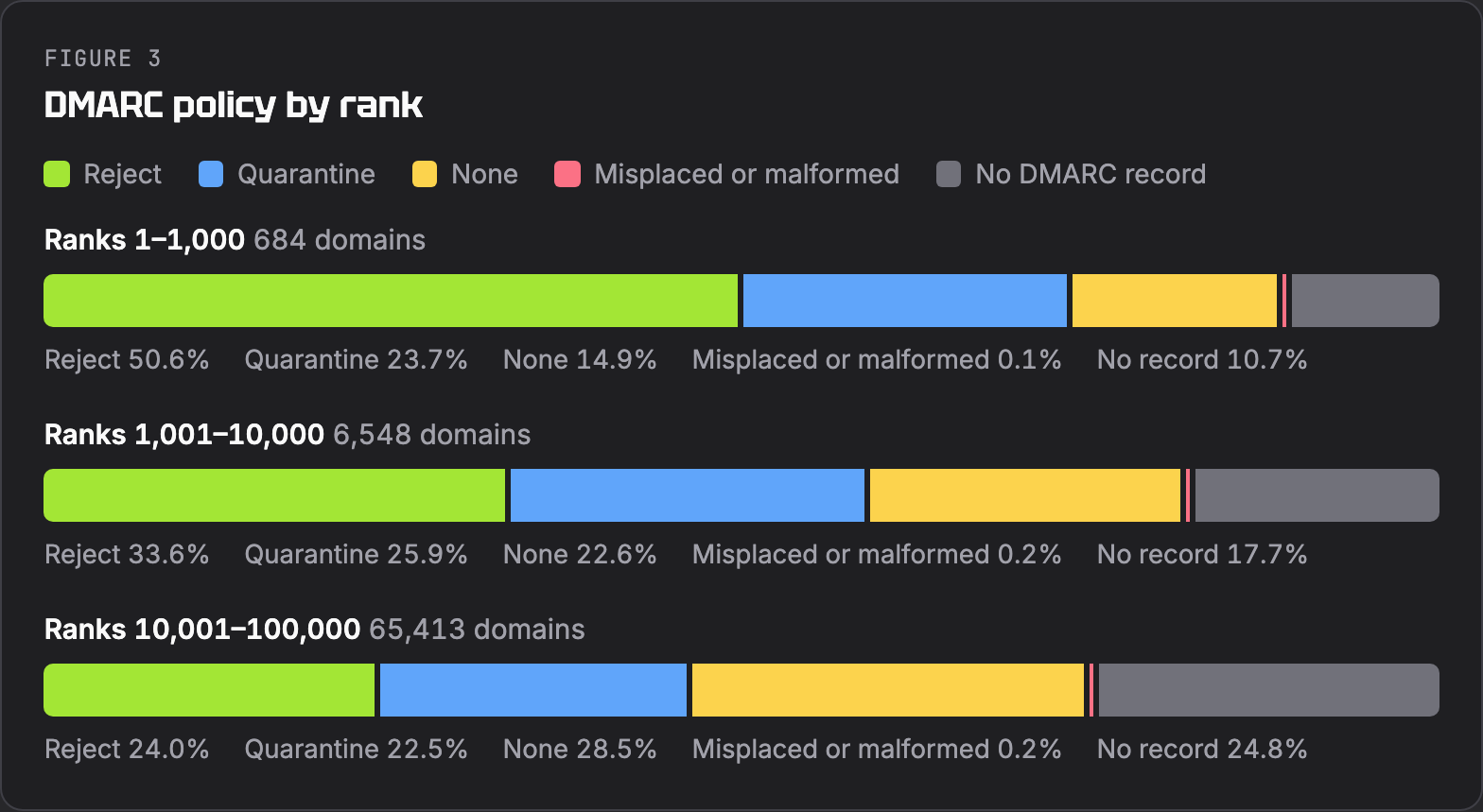
Analyzed domains with a non-null MX in each rank group.
Records that don't do what they say
- 152 records are in the wrong place. These domains have no record at
_dmarcand none above it, only a DMARC record in the domain's own TXT records, where receivers don't look. - 15 records have a
p=value receivers don't recognize:quarentine(2), an emptyp=(2),p=quarantine\;with escaped semicolons (3), and one each ofquarantaine,rejeitar,nonr,rnone,no,100,p=quarantineandnonewith no semicolon beforerua. - 2,756 domains publish an enforcing policy alongside
sp=none, 7.1% of the 38,595 analyzed domains withrejectorquarantine. What applies to a given subdomain depends on its own record and, under RFC 9989, onnpfor subdomains that don't exist. - 1,848 domains publish the legacy
pcttag with a value below 100, including 143 withpct=0; 1,494 of them userejectorquarantine. RFC 9989 removespct, so we report it as published and count those domains under theirp=value. - 1,748 domains publish
rejectorquarantinewhile the checker flags an SPF error on the domain itself. For a message whose SPF evaluation actually returnspermerror, passing DMARC would require an aligned DKIM signature.
2,094 domains publish the combination used to park a domain: no MX record, an SPF record of v=spf1 -all and p=reject. A null MX on its own doesn't cover spoofing: of the 412 domains with one, 84.2% publish SPF and 78.2% DMARC.
DMARC reporting addresses
Of the 59,896 domains with a DMARC record, 51.4% list a rua address outside their own organizational domain, 27.4% list only addresses on their own domain, and 21.2% list none. Higher-ranked domains are more likely to use an outside address.
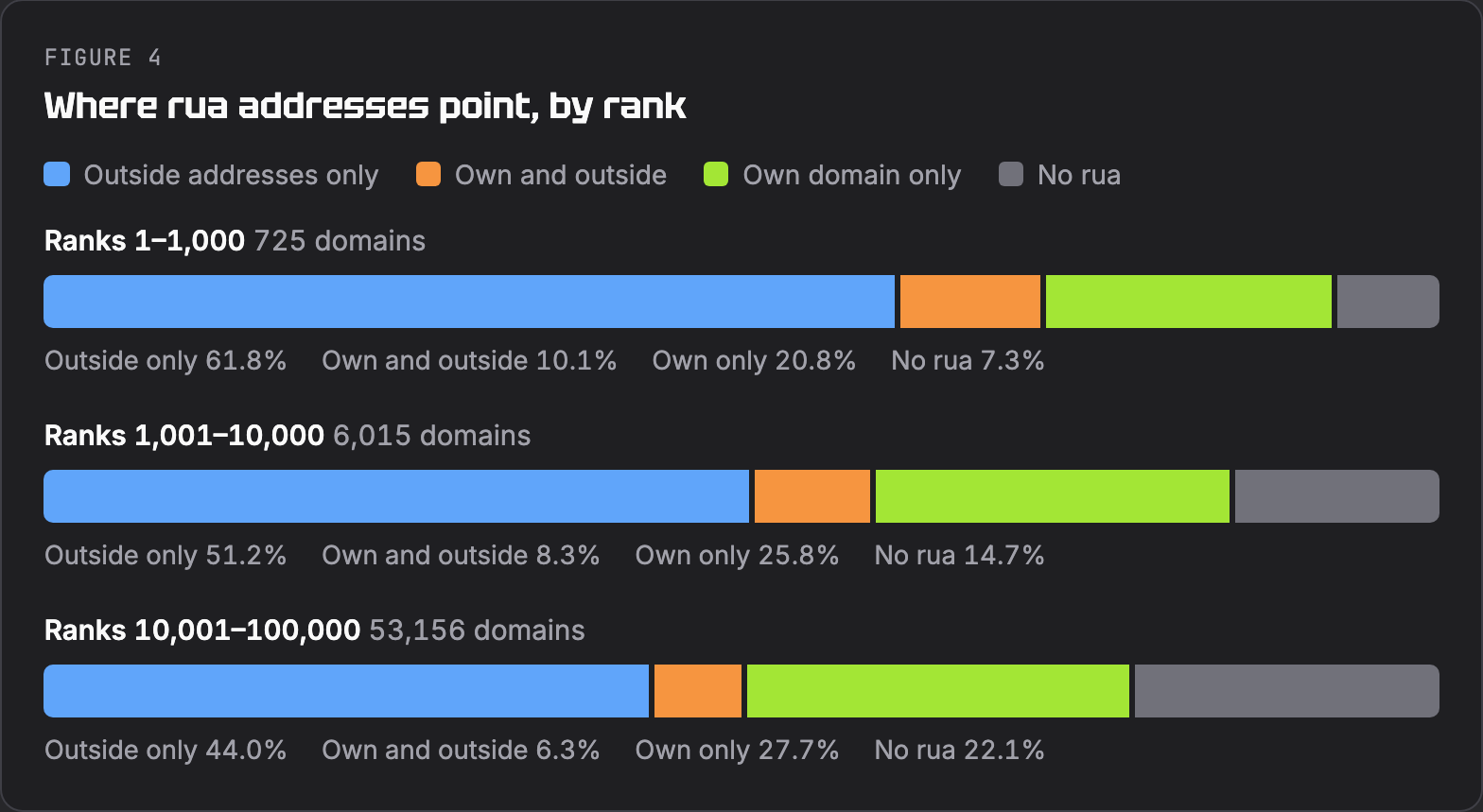
Analyzed domains with a DMARC record in each rank group. "Own" means the same organizational domain as the policy domain, by the Public Suffix List.
Policies without a reporting address
Aggregate reports are how a domain owner learns which sources fail authentication at receivers that send them. Records without rua are far more likely to use p=none, the policy meant for collecting those reports before enforcing.
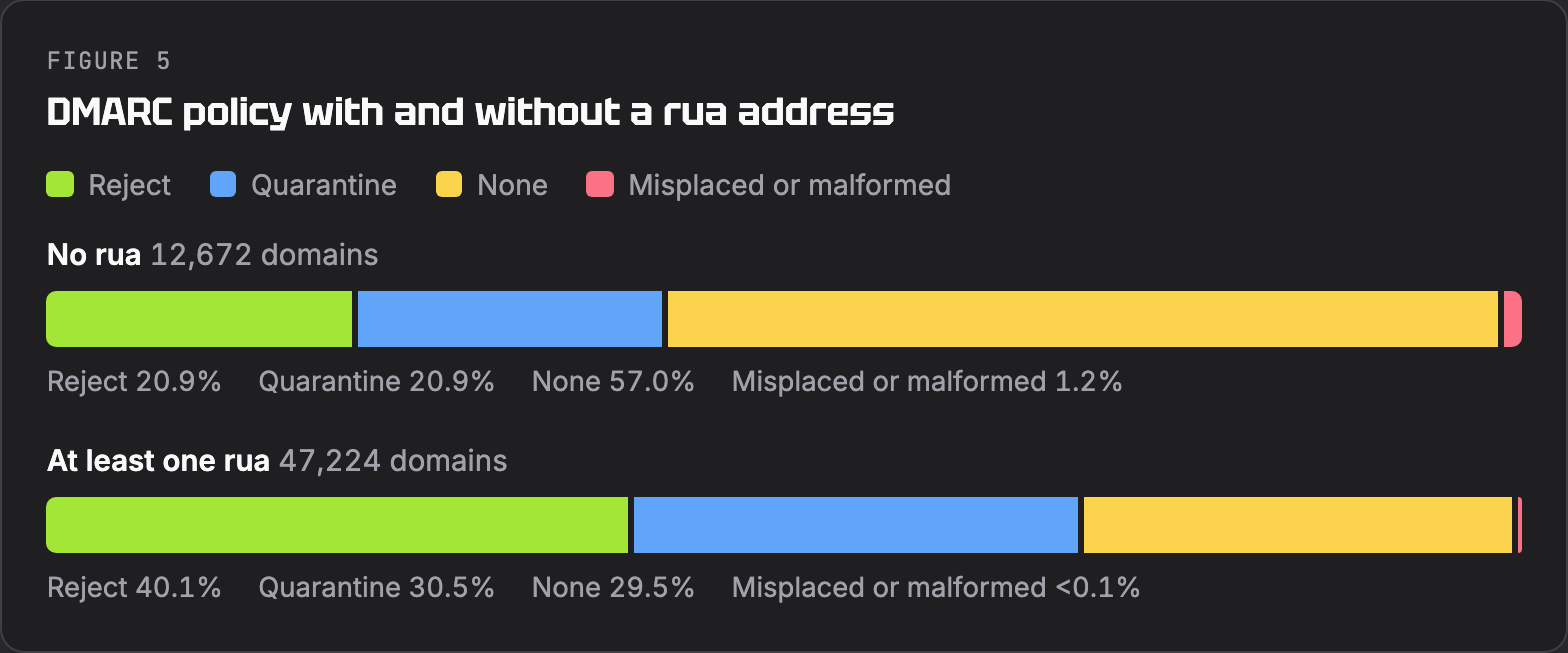
12,672 domains with a DMARC record and no rua, and 47,224 with at least one rua address.
7,218 domains publish p=none with no reporting address, so their records give receivers no destination for aggregate reports. Another 5,296 publish reject or quarantine without one, so if a legitimate source starts failing, these records bring them no aggregate reports to show it. The scan can't tell whether their owners watch authentication another way, through provider tools or sending logs.
DMARKOFF gives you an address for the rua tag, collects the reports and shows each source's SPF, DKIM and DMARC results. If a domain's compliance rate drops, it sends you an alert.
Who the outside addresses belong to
We matched outside rua addresses to the organizations behind them. 22,496 domains list a DMARC vendor. 1,698 list a sister domain of their own company, such as YouTube reporting to Google. 646 list a government collector: CISA for US federal agencies, the UK's NCSC Mail Check, Spain's CCN-CERT and Saudi Arabia's NCA among them. 544 list a personal mailbox at a provider such as Gmail, QQ Mail or NetEase, and 7,284 list organizations we couldn't identify. A domain with several addresses can fall into more than one group.
Receivers send reports to an outside domain only if that domain authorizes it with a DNS record (RFC 9990, section 4). 4,875 of the 30,816 domains with an outside address (15.8%) list at least one whose domain doesn't. Mailbox users can't publish that record themselves; whether it exists is up to the provider. All 186 domains listing Gmail destinations lacked the required authorization, and so did all 124 listing QQ Mail destinations, while NetEase publishes a wildcard authorization for its business mail host, qiye.163.com.
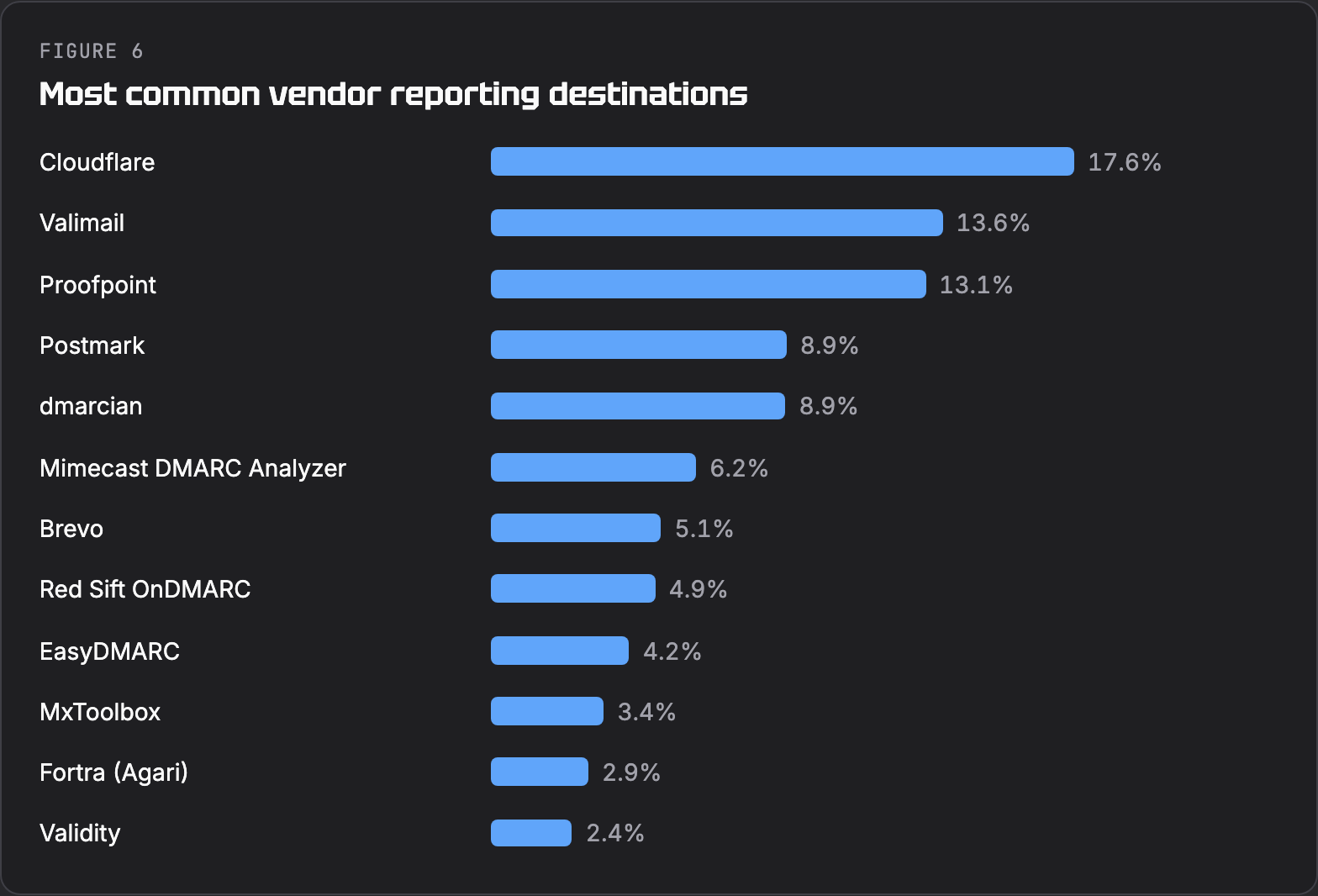
Share of the 22,496 analyzed domains with at least one vendor rua address; a domain listing two vendors counts for both. This counts domains, not customers, revenue or mail volume, and the 7,284 domains with unidentified destinations make every count a floor.
Cloudflare offers DMARC Management to domains on its DNS, which may explain part of its lead. 2,325 domains, 10.3% of those with a vendor address, list two or more vendors. Some may be mid-migration; a single DNS snapshot can't tell that apart from deliberate use of several services.
SPF errors and reporting addresses
Comparing groups of domains by their reporting addresses, SPF errors were less common among domains with a vendor address. This is a description of the sample, not evidence that vendors fix records: domains using vendor reporting addresses may differ in other ways, and the scan can't tell whether reports were delivered or read.
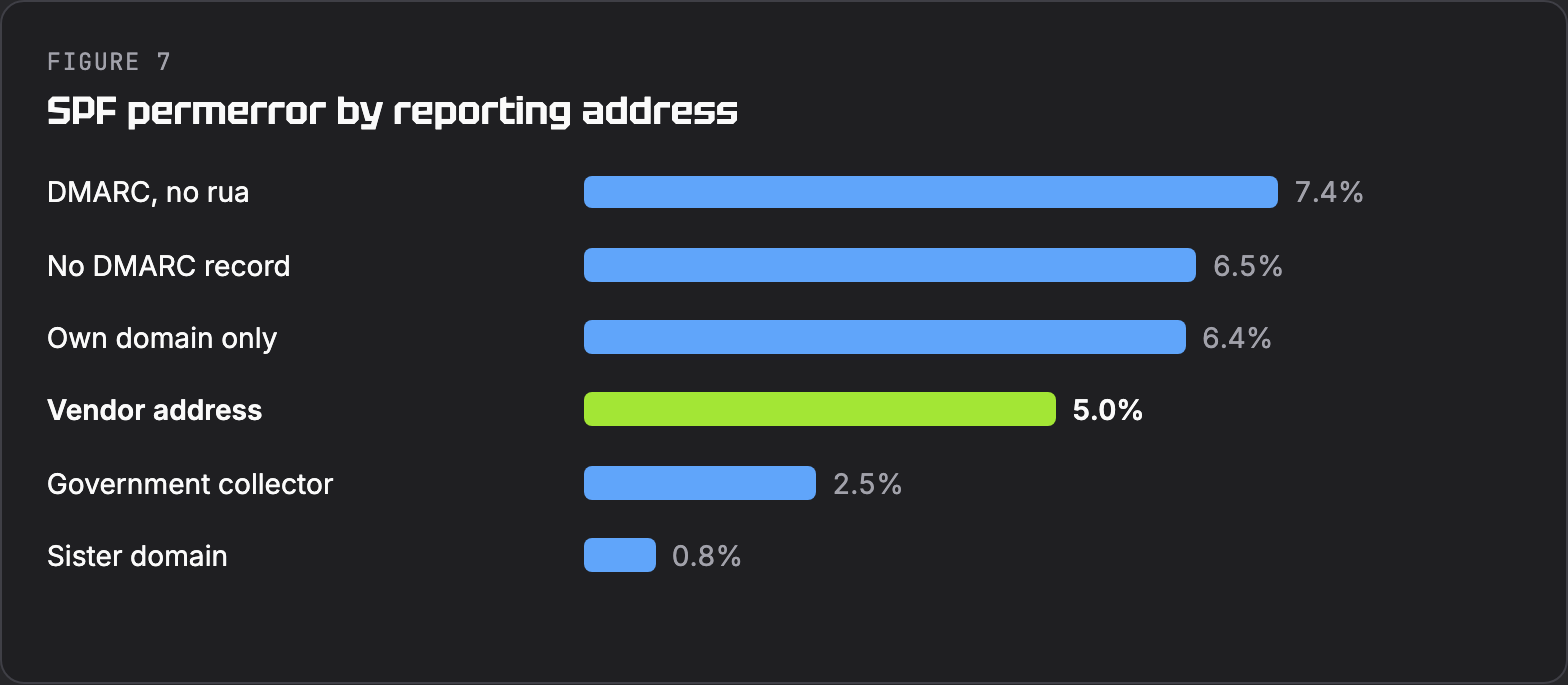
Share of analyzed domains with at least one SPF record whose SPF ends in permerror. A domain with addresses in two groups counts for both.
The gap is 1.4 percentage points against domains whose addresses are all on their own domain, and 2.4 points against domains with no rua. In absolute terms, the scan still flagged SPF errors on 1,086 domains with a vendor reporting address.
The gap remains within the two larger rank groups. In ranks 1,001 to 10,000, 4.5% of domains with a vendor address were flagged, against 5.2% for own-domain-only and 6.7% for no rua; in ranks 10,001 to 100,000 it was 5.1%, 6.5% and 7.5%. The top-1,000 groups contain only 50 to 319 SPF-publishing domains each, so we don't draw conclusions from that stratum.
MTA-STS, TLS-RPT, DNSSEC and BIMI
Beyond SPF and DMARC, adoption among domains with a non-null MX drops to single digits.
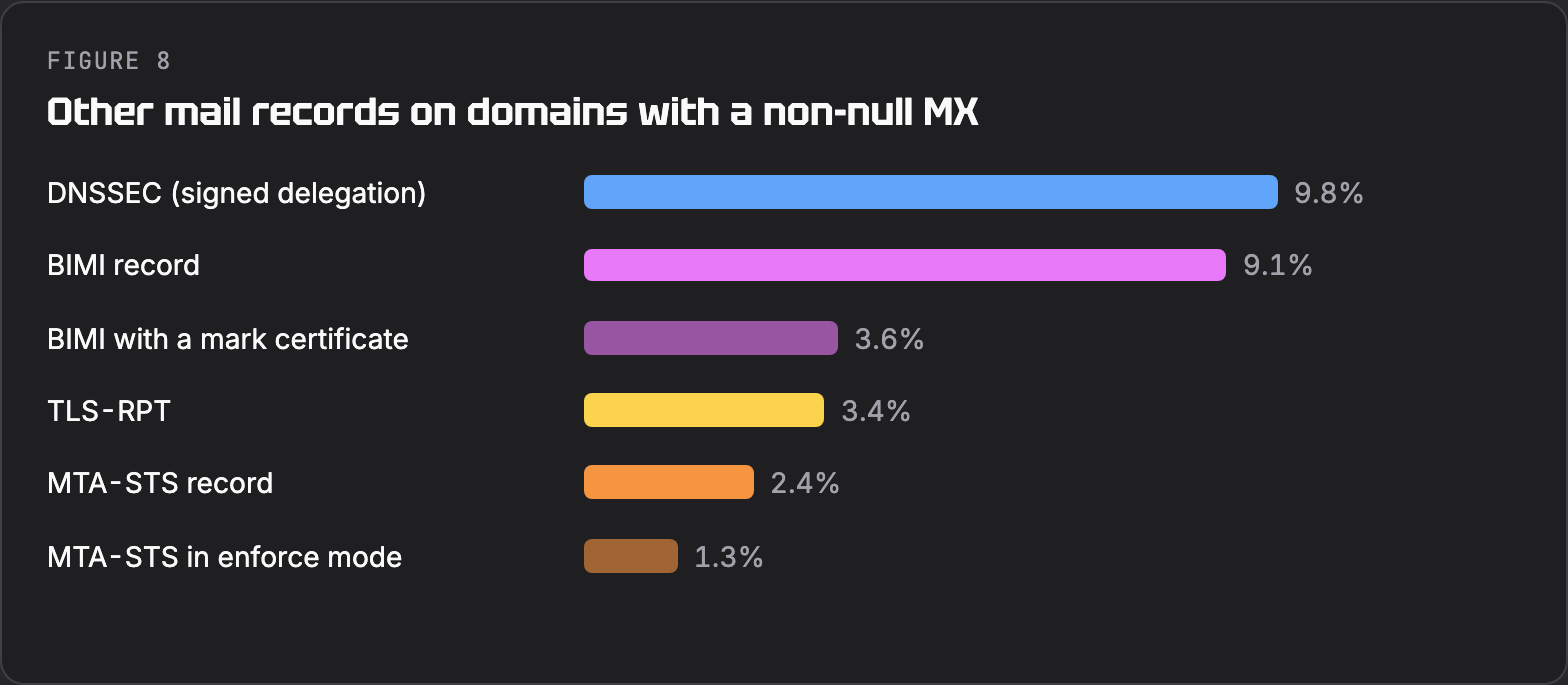
Share of the 72,645 analyzed domains with a non-null MX that publish each record. MTA-STS counts the TXT record; enforce mode counts those whose policy, fetched over HTTPS, is in that mode.
Of the 1,742 domains with an MTA-STS record, 957 serve a policy in enforce mode, 760 in testing and 25 in none; 1,572 of them also publish TLS-RPT, which is what makes failures visible in testing mode. 7,131 domains with MX have a signed DNSSEC delegation (a DS record in the parent zone), and two of them failed validation.
BIMI
7,013 domains publish a BIMI record at the default selector, and 2,893 of those records point to a mark certificate. Gmail, among others, shows a logo only with DMARC at p=quarantine or p=reject and, per Google's setup guide, pct=100. 1,403 BIMI records don't meet that: 698 sit on domains with p=none, 609 with no DMARC record, 89 with pct below 100 and 7 with a malformed policy. Meeting it doesn't guarantee a logo; each provider decides.
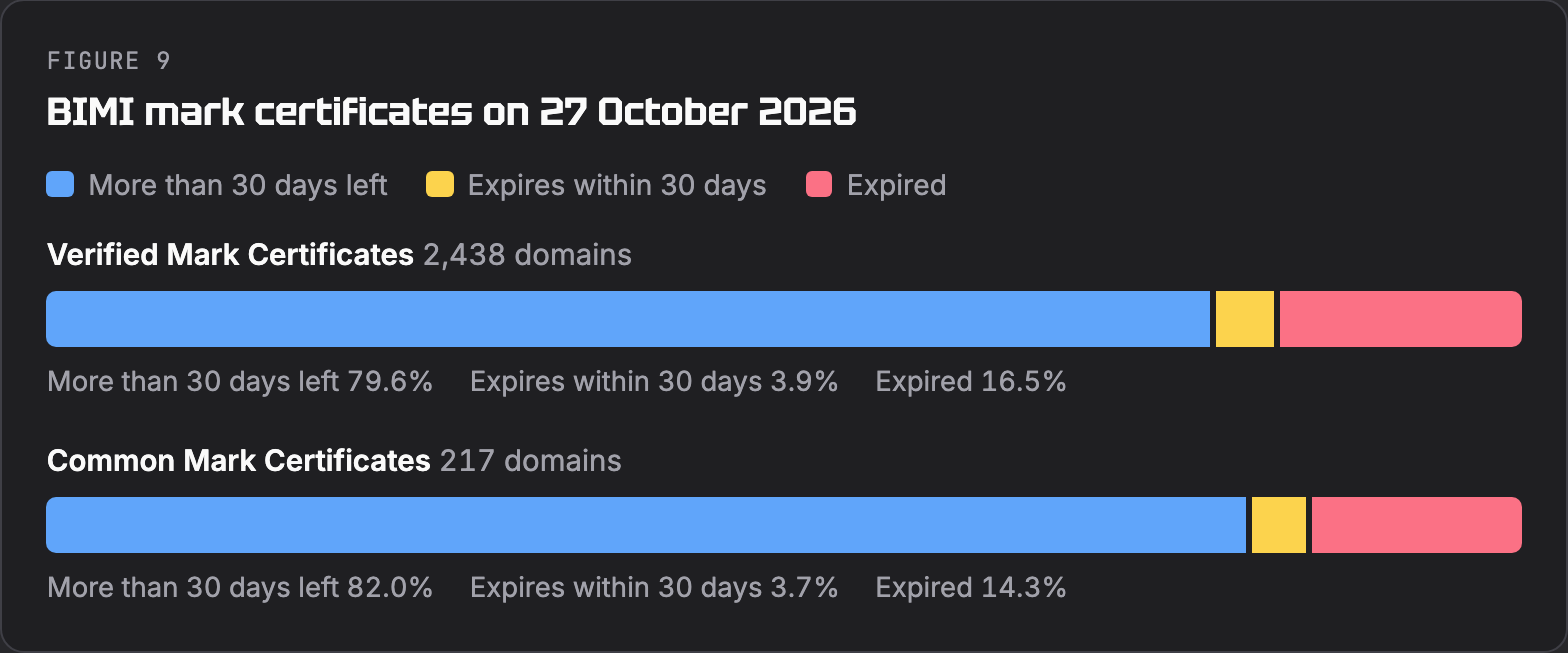
The 2,655 mark certificates we could download and read, out of 2,893 a= URLs in BIMI records, one per domain, by type (Verified Mark Certificate or Common Mark Certificate) and by the expiry date in the certificate. 433 (16.3%) had expired, some more than a year earlier.
What to check on your own domain
- Count the SPF lookups a sender you don't list would trigger, nested includes included, and keep a margin below 10. Check what an include costs before adding it.
- Make sure every include resolves and that the domain behind it belongs to a service you use.
- Publish DMARC at
_dmarc.plus your domain, with a validp=and aruaaddress. - Check the policy that applies to each subdomain you send from, not only the parent's
sp. - For an outside
ruaaddress, check that the destination domain authorizes your reports. Users of public mailbox services generally can't publish that record themselves. - If you use BIMI, enforce DMARC and track the certificate's expiry date.
The DMARKOFF Email Security Checker runs these checks for one domain: the SPF lookup count and every include, the DMARC record and the authorization of each rua address, MTA-STS and BIMI. The single-record SPF, DMARC, BIMI and MTA-STS checkers go into more detail.
Methodology
- List: the standard Tranco list W3ZV9 (registrable domains, generated 25 October 2026), first 100,000 entries.
- Scan: 27 October 2026, 20:48 to 21:06 UTC, from our own DNSSEC-validating recursive resolver in AWS us-east-1, with a 30-second budget per domain. A domain was retried, from 21:07 UTC with 60 seconds, when its checks didn't finish in time, its SPF evaluation returned temperror or its DMARC lookup failed. That happened to 710 domains; the 559 that failed again are excluded from every figure. NXDOMAIN and empty answers count as answers. Lookup errors in other checks don't exclude a domain and are counted where they occur: the authorization lookup failed for outside
ruaaddresses of 12 domains, and 2 domains with DNSSEC failed validation, which the checker reports as a validation failure rather than a temporary one. - Checker: DMARKOFF's record checker (v1.21.2), the engine behind our free tools. SPF lookups and void lookups are counted for a sender the record doesn't list (
192.0.2.1, envelope senderpostmaster@plus the domain), as above. A domain has SPFpermerrorwhen one of five checks fails: syntax, several records, an include or redirect target, the lookup limit or the void-lookup limit. - DMARC: records are discovered with the DNS tree walk of RFC 9989. A record found only in the domain's own TXT records is reported as misplaced. Legacy tags such as
pctare reported as published. - Reporting addresses: each
ruaaddress is grouped by its organizational domain under the Public Suffix List, compared with the policy domain's, and checked for the authorization record of RFC 9990, wildcards included. Outside destinations were matched by hand to 108 organizational domains and grouped as vendor, sister domain, government collector or personal mailbox. - MTA-STS, TLS-RPT, BIMI, DNSSEC: TXT records at their standard names. MTA-STS policies were fetched over HTTPS. BIMI records were queried at the default selector, and their certificate URLs were fetched over HTTPS; certificate expiry is the certificate's own notAfter date. DNSSEC counts a signed delegation (a DS record in the parent zone) and checks that it validates.
- Missing include targets: includes and redirects that returned NXDOMAIN, classified by NS queries for the registrable domain and its suffix; the 14 registrable domains that didn't resolve were checked with RDAP and registry WHOIS on 28 October 2026.
- Not measured: outgoing mail and the identities it uses, delivery outcomes, whether DMARC reports are received or read, DKIM, blocklists.
- Data: the aggregate tables, queries and a script that recomputes every share in this report are on GitHub.
FAQ
91.5% of the 72,645 analyzed domains with a non-null MX record published SPF; across all 99,441 analyzed domains, 71.5% did.
60.2% of the 99,441 analyzed domains in the Tranco top 100,000 had a DMARC record on 27 October 2026. Among the 72,645 with a non-null MX record, 76.0% did. Both counts include misplaced and malformed records.
38.8% of the 99,441 analyzed domains published p=reject or p=quarantine, and 21.7% published p=reject. Among the 72,645 with a non-null MX record, 47.9% and 25.2% did. Among domains with a non-null MX in the top 1,000, 74.3% published either policy.
Not necessarily. SPF permerror means SPF can't authenticate the message, but DMARC can still pass with an aligned DKIM signature, and delivery is each receiver's decision. In our test of 21 mailbox providers, some returned spf=pass for a record over the lookup limit and others refused the messages.
A DNS-only scan can't reliably tell whether a domain signs its outgoing mail. DKIM keys sit under selectors that appear in message headers, and DNS offers no way to list them.
Tranco ranks domains by popularity signals such as traffic, not by mail volume. The results describe these 100,000 domains on one day; smaller domains and later dates may look different.
Yes. The aggregate tables behind every figure, the queries that produced them and a script that recomputes every share are on GitHub. We don't publish per-domain results.

Co-founder & CTO at DMARKOFF and GlockApps, email security specialist with 20+ years of experience, Golang & ClickHouse expert. A happy father of two teenagers.