
SPF ~all vs -all Under DMARC p=reject: We Tested 20 Providers



In our October 2026 scan of the Tranco top 100,000, half of the SPF records ended in ~all and 45.1% in -all. Does the difference matter once a domain publishes a DMARC policy? Microsoft's SPF setup guide, last updated in July 2026, says it does: DMARC counts both as SPF failures, but "the DMARC policy is effectively ignored for SPF ~all failures" when the message has no DKIM signature. It recommends -all for that reason.
The standard reads differently. RFC 9989, the current DMARC specification, counts SPF toward DMARC when the result is a pass on a domain aligned with the From address. A fail, a softfail and a neutral all miss that bar in the same way.
So we asked the receivers. On 2 November 2026 we published three SPF records that differ only in the all qualifier, each on its own subdomain with p=reject, and sent them without an aligned DKIM signature to 42 seed mailboxes at 20 providers. On 4 November we sent the same records with an aligned signature to the three receivers where the qualifier had changed the refusal, plus Gmail and Outlook.com for reference. This is a follow-up to our study of broken SPF records. For the general difference between SPF softfail (~all) and hardfail (-all), see our comparison guide. Here we test what changes under DMARC p=reject.
Disclosure: DMARKOFF builds DMARC monitoring tools, and we read the receivers' aggregate reports for this test in DMARKOFF. The seed mailboxes came from GlockApps, which is made by the same team. All domains and accounts were our own, and the data behind every claim is on GitHub.
TL;DR
- Microsoft didn't ignore
p=rejectfor~all. On mail with no DKIM signature, Outlook.com and Hotmail refused-all,~alland?allalike with550 5.7.509, and Microsoft 365 accepted all three and bounced them with the same code. Their aggregate reports recordsoftfail, DMARCfailand the dispositionrejectfor~all, with no override. - Without aligned DKIM, no provider let
~allinto a mailbox after refusing-all. 16 of the 20 providers treated all three records the same way. Naver, Interia and Onet refused-allciting SPF, but the other two records didn't reach the mailbox there either. - With aligned DKIM, the qualifier decided delivery at Onet. It refused signed
-allmail before the signature arrived, and put the same mail under~alland?allin the inbox. That's the early SPF refusal RFC 9989 warns about. - A signature got the mail delivered at Gmail, Outlook.com and Naver, but not at Interia. The first three delivered all three records, though not always to the inbox. Interia refused
-alland deferred~alland?alluntil the sender gave up. - T-Online and Vodafone delivered to the inbox mail that failed DMARC under
p=reject. That held for all three records, sent through Mailgun. Both refused our own server's IP in the first study, so this shows they don't apply the policy, not that anyone can forge a sender there.
The test
The address 192.0.2.1 comes from a range reserved for documentation, so it matches no real sender and the all term decides the result. Each subdomain was both the From domain and the MAIL FROM domain, and each published p=reject.
We sent through Mailgun's shared IPs because in the first study Microsoft refused our own blocklisted AWS sending IP on the direct path. DKIM signing for our domains was off. Mailgun adds its own d=mailgun.org signature to mail for some receivers, which doesn't align with our domains. When we inspected headers in our earlier run, that signature went to Gmail, the Yahoo family and GMX, not to Microsoft, so Microsoft's mailboxes should have received mail with no DKIM signature at all, the condition in its note. Microsoft's reports for this run are consistent with that: they contain no DKIM results for these domains.
Each case went out once, to the same addresses: 42 mailboxes at 20 providers, plus filter seeds and a monitoring address. We counted providers as in the first study, without Proton, whose seed is gone: Outlook.com, Hotmail and Microsoft 365 count as one provider, Microsoft, and so do Gmail and Google Workspace, Yahoo, AOL and AT&T, GMX, WEB.DE and mail.com, and Libero and Virgilio. The filter seeds aren't providers. For each message we recorded Mailgun's delivery event, the folder it landed in, and the receiver's aggregate report where one exists.
The control reached all 44 tracked seeds: 30 in the inbox, 1 in a tab and 13 in spam. Outlook.com, Hotmail, the Yahoo family, Apple and Yandex put even the control in spam, so at those receivers a spam folder says little about SPF.
Results without aligned DKIM
refused: rejected during the SMTP session. bounced: accepted, then returned as undeliverable. deferred: temporarily refused until the sender stopped retrying. dropped: accepted without a bounce, and not seen in the seed mailbox by the time we read the results on 5 November.
¹ Two of the four mailboxes sit behind spam-filter seeds.
² First attempt greylisted with 457, delivered on the retry about 10 minutes later. The control went through at once, to the inbox.
Sixteen of the 20 providers treated the three records the same: nine refused or bounced all of them, and seven delivered or dropped all of them. The other four, Naver, Interia, Onet and Yandex, have their own section below. None of the 20 refused -all and then put ~all or ?all in a mailbox.
What Microsoft did
Outlook.com and Hotmail refused all six mailboxes' copies of each failing record during the SMTP session, with the same reply each time: 550 5.7.509 Access denied, sending domain … does not pass DMARC verification and has a DMARC policy of reject. Microsoft 365 answered 250 for all three, then returned each message with the same code, the pattern we described in our guide to bounce codes. The control went through at both.
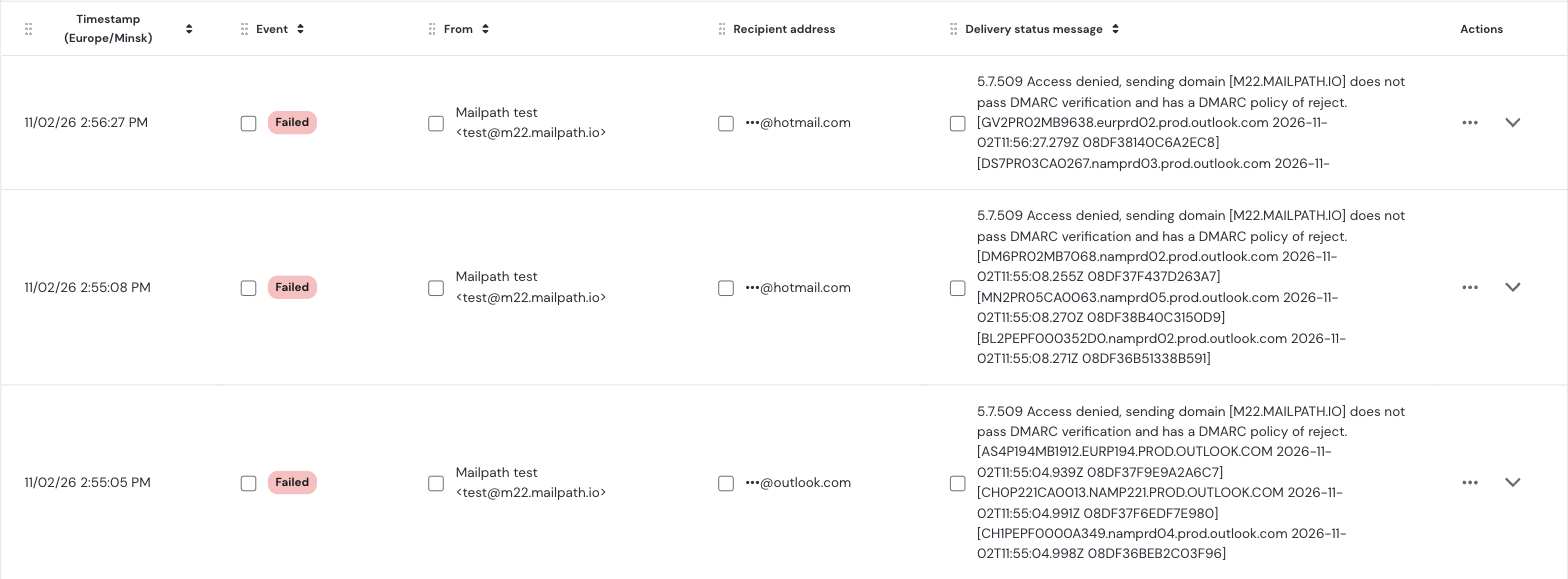
Both services' aggregate reports agree. For ~all, they record softfail, DMARC fail and the disposition reject, and -all and ?all got the same disposition with fail and neutral. No row carries a policy override or a comment, and none has a DKIM entry, which is consistent with the condition in Microsoft's note: an SPF softfail with no DKIM signature.
So the behavior in Microsoft's note didn't show up in this test. We don't know what the note rests on. It may describe older behavior, or a condition we didn't reach, such as a different sending IP or a receiving tenant's own settings. One run through shared IPs can't show that it never happens, but it does show that ~all on unsigned mail doesn't get a free pass by default.
Where the qualifier changed the refusal
Three receivers cited SPF, not DMARC, when they refused -all, and treated ~all and ?all in another way:
- Interia refused
-allwith550 5.7.1 … Rejected due to SPF. It deferred the other two with451 4.4.0 … Deferred due to SPF unsafe, for eight hours, until Mailgun gave up. - Onet refused
-allwith550 5.7.23 … SPF fail, and the other two with a plain554 5.7.1 Rejected. - Naver refused
-allwith550 5.7.1 Sender rejected because SPF check failed. It accepted the other two with250, and they never reached the mailbox.
That split fits RFC 7208, which says receivers shouldn't reject on a softfail alone. It also raises the question behind RFC 9989's warning in section 7.1: a receiver that checks SPF early can refuse a -all failure before DMARC runs, so a message that would pass on an aligned DKIM signature can still be lost. By the same section, such a refusal never appears in an aggregate report. Interia's reports have no entry for any of these three domains.
Yandex went the other way: it accepted -all and put it in spam, and refused ~all and ?all with 550 5.7.1 Email rejected per DMARC policy. That was one message per case. In the first study, Yandex refused a -all failure with the same code, and it put this run's control in spam too. We read this as Yandex being inconsistent, not as -all being weaker there.
What happened when we signed the mail
A reply that cites SPF doesn't show whether an aligned DKIM signature would have saved the message. So on 4 November we sent the same three records again with Mailgun signing for the From domain. The control was m00, with a passing SPF record and the same kind of signature. We sent to the three receivers above, and to Gmail and Outlook.com as a reference. Where a receiver refused or deferred at the RCPT TO step, the reply came before the message and its signature were sent; for accepted mail, the receiver's own authentication headers show what it checked.
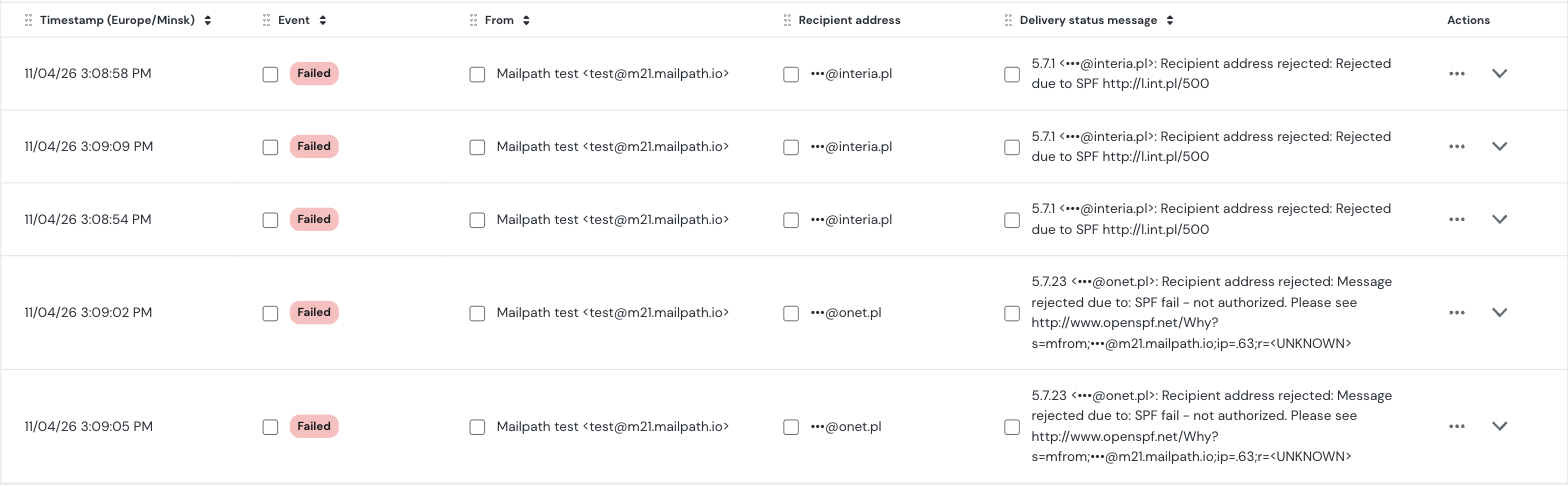
- Onet is the case RFC 9989 warns about. It refused
-allat theRCPT TOstep with550 5.7.23 … SPF fail - not authorized, before the message or its signature is sent. The same signed mail under~alland?allreached the inbox, and Onet's own headers recordspf=softfailorspf=neutral,dkim=passanddmarc=passunderp=reject. Here the qualifier decided delivery. - Interia answered before it could see the signature. As in the unsigned run, it replied at
RCPT TO:-allwas refused, and~alland?allwere deferred with451 4.4.0 … SPF unsafefor eight hours, until Mailgun gave up with602 Too old. The control reached the Offers tab, and Interia's report lists only the control, with SPF, DKIM and DMARC passing. So~alldidn't save a message at Interia that the SPF record doesn't cover. - Naver delivered the SPF-failing mail in the signed follow-up. It accepted all three, and its headers record
dkim=passanddmarc=passnext tospf=fail,softfailorneutral.-allwent to spam and the other two to the inbox. So the replySender rejected because SPF check failedin the unsigned run doesn't establish a blanket rule that Naver rejects an SPF fail before checking DKIM: with an aligned signature, the mail got through. - Gmail and Outlook.com delivered all three. Gmail put them in the inbox. Its aggregate report records
failfor-all,softfailfor~allandneutralfor?all, with DKIMpasson our domain, DMARCpassand the dispositionnone. Outlook.com put the control in the inbox and all three failing records in spam, withdmarc=pass,compauth=passand a spam confidence level of 5 in the headers. Its report records the same three SPF results, with DKIMpasson our domain, DMARCpassand the dispositionnone. Authentication passed, so that folder came from its filter. We can't say why: it was one mailbox, and the control domain has a longer history.
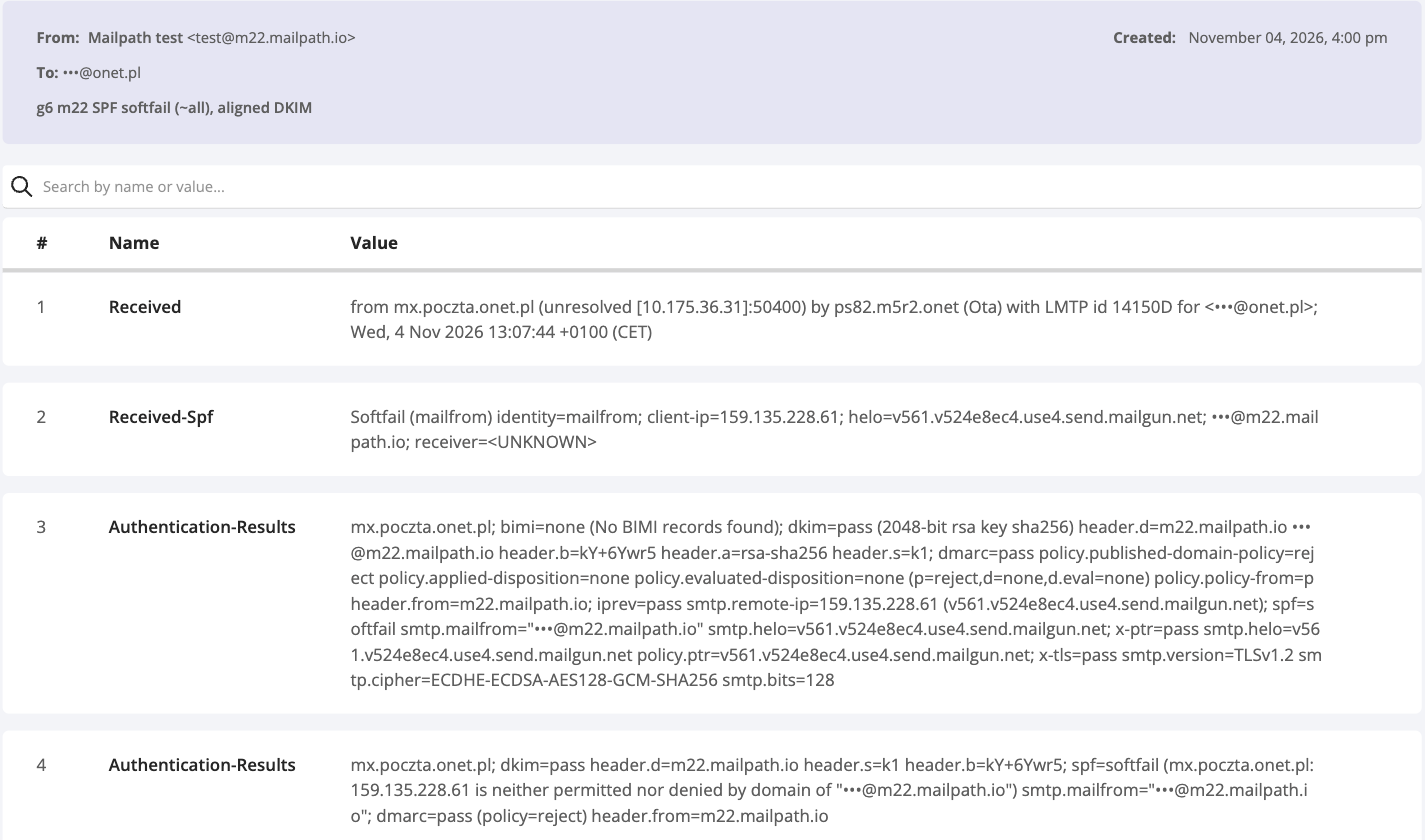
A signature got mail that fails SPF delivered at four of these five receivers, and at Onet that depended on the qualifier. This was one to three mailboxes per receiver, so read it as what these mailboxes did that day, not as each provider's rule.
What the receivers' own reports say
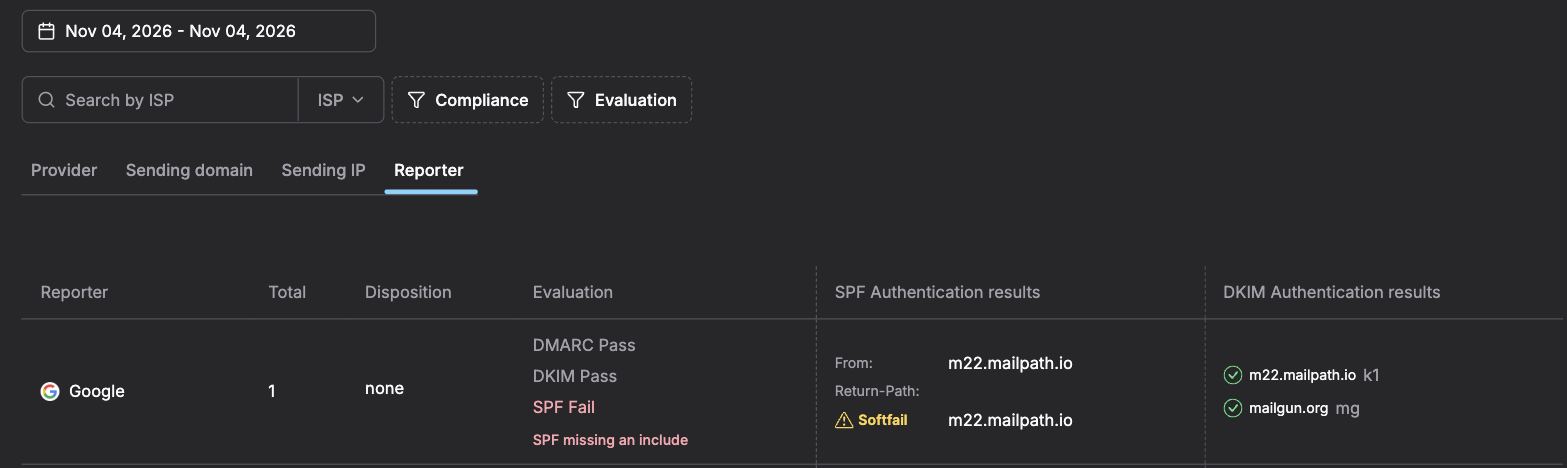
Each cell shows the SPF result the receiver recorded for the unsigned mail and the disposition it reported. DMARC failed on every row below that has a report, and the control passed.
³ The reports list fewer refused messages than we sent for this case: 3 of 4 for GMX, WEB.DE and mail.com, and 5 of 6 for Outlook.com. Every other count matches the seeds.
⁴ Zoho's report gives a window that ended before we sent the mail, as in our earlier runs. Its verdicts match its SMTP refusals.
⁵ La Poste reported on our earlier tests but has sent us no reports since late October, so this run has none from it.
These receivers read ~all as softfail and ?all as neutral, and rejected the mail anyway. All of Yahoo's records and half of Google's also carry Mailgun's d=mailgun.org signature with a pass, which changes nothing, because it doesn't align with our domains. Microsoft's and Zoho's rows have no DKIM entry at all, and no row in this table carries a policy override.
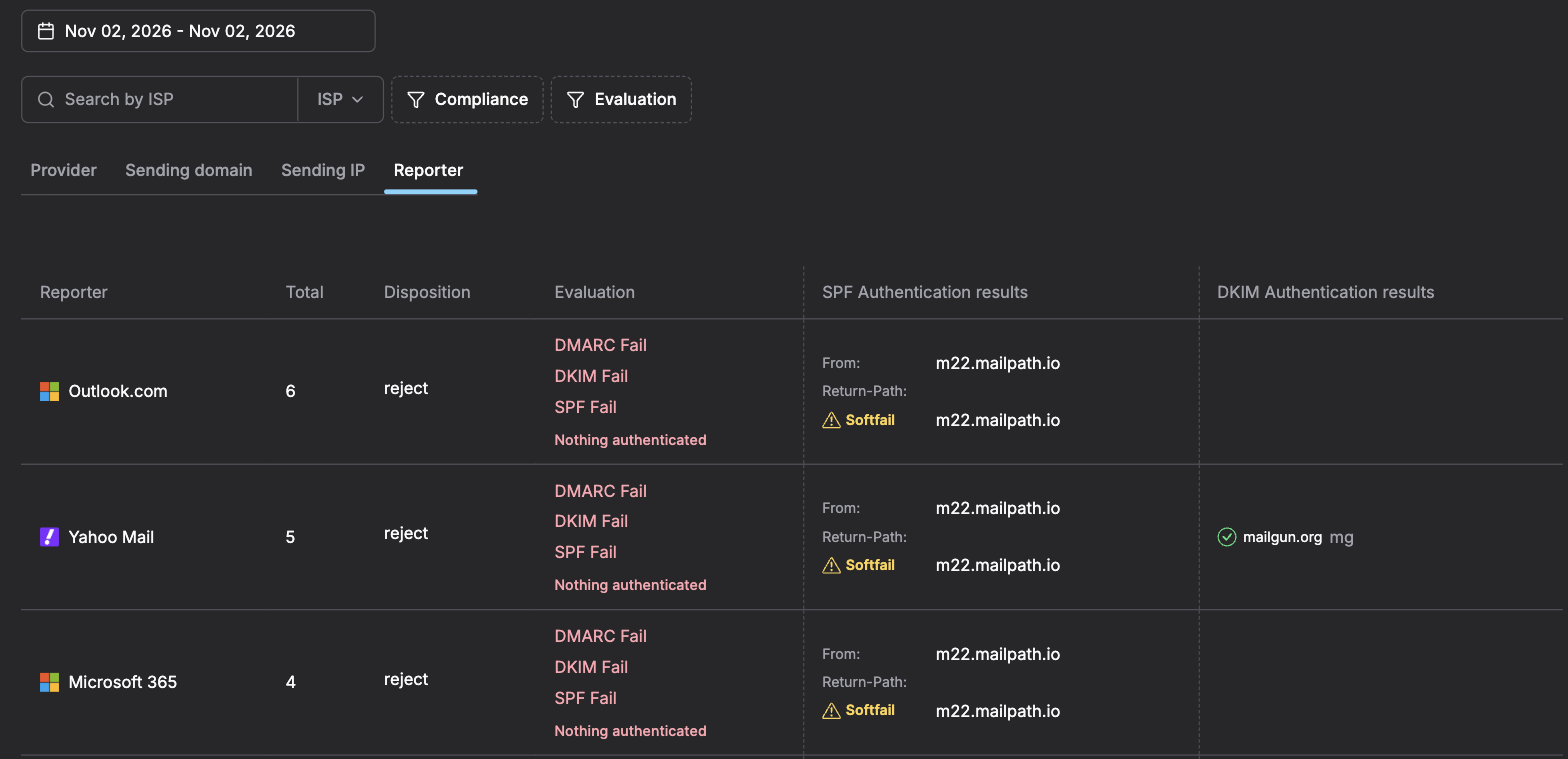
Seznam stands out again. It answered 250 to all three, then reported them as reject and didn't deliver them. Without the report, the only sign would have been an empty seed mailbox.
We read these reports in DMARKOFF, which shows each domain's results by reporter.
Two providers delivered all of it
T-Online and Vodafone delivered to the inbox mail that failed DMARC under p=reject. They did it here for all three records, and in the first study for a -all failure and for a domain with no SPF record at all. The headers we read, in this run and the first study, record dkim=none and no SPF or DMARC result.
The standard allows this. RFC 9989 lets a receiver accept mail that fails DMARC under p=reject, and section 7.4 says it must not reject on that policy alone, so this isn't a violation.
For a domain owner, that means p=reject didn't keep this mail out of the inbox at these two receivers. It's a narrower finding than "you can forge a sender there", for four reasons:
- The mail came through Mailgun, from shared IPs with a sending history, on domains Mailgun had verified before we changed their records. We didn't test whether that path works for a domain the sender doesn't control. When we sent directly from our own AWS address in the first study, both refused every case, clean controls included: T-Online when we connected (
554 … Dialup/transient IP not allowed), Vodafone at the recipient (554 5.7.1 … blocked using Abusix Mail Intelligence). - We used our own new subdomains. We didn't try a well-known domain, and we don't know whether these receivers protect those separately.
- The content was harmless, at one message per case. Phishing text or volume may meet filters this test didn't reach.
- Not applying a policy isn't the same as not checking SPF. A DNS log from a separate run suggests, by timing, that Vodafone fetches SPF records seconds after it accepts a message. T-Online's resolvers didn't show up in that log, so we can't say either way for T-Online.
Others let the mail reach the mailbox in the spam folder: freenet, Libero, Virgilio and ukr.net for all three records, and Yandex for -all. None of these providers, nor T-Online or Vodafone, sent an aggregate report in the first study, so a domain owner wouldn't see any of this in DMARC reports.
What to do with your own record
- Get to
p=rejectwith aligned DKIM first. A signature is what got mail that fails SPF delivered at Gmail, Outlook.com, Naver and Onet, and RFC 9989 section 7.4 says a domain publishingp=rejectmust sign its mail rather than rely on SPF alone. No qualifier stands in for it. - If you already publish
~allunderp=reject, this test gives no reason to treat it as a loophole. Without an aligned DKIM signature, it failed DMARC just as-alldid, at Microsoft and at the other providers that apply DMARC. - Use
-allwhen every sender is listed, and know the trade-off. Microsoft recommends it, and it says the most clearly that unlisted senders aren't authorized. But a sender your record misses can lose signed mail: Onet refused it under-alland delivered it under~all, which is what RFC 9989 warns about. If you choose-all, test important delivery routes as well as your sender inventory: forwarding can produce an SPF fail even when the original sender is listed, and an early SPF refusal can then stop an aligned DKIM signature from being checked. - Prefer
~allwhile you're still finding your senders. In our signed run, it reached the inbox at Onet and Naver where-alldidn't. It made no difference at Gmail and Outlook.com, and it didn't save the mail at Interia, so it gives you some margin but doesn't replace listing the sender. - Don't pick
?allbecause of these tables. With a signature it did no better than~all, and without one it was refused because ofp=reject. RFC 7208 treats neutral like no SPF result at all, so without an enforcing policy it says nothing to a receiver. - Don't apply these results to a domain without an enforcing policy. Every domain in this test published
p=reject. Underp=none, or with no DMARC record, the qualifier may matter more. - Read your reports by reporter. A
softfailnext torejectis normal underp=reject. It means an unlisted sender or a record that needs fixing, whichever qualifier you use.
You can paste a draft record into DMARKOFF's SPF checker before you publish it.
Limitations
- Two runs, one message per mailbox. Each record went out once per run, to one to six mailboxes per provider. Receivers can be inconsistent, as Yandex was.
- Mailgun's shared IPs only. Our own address is blocked at many of these receivers, so this run says nothing about how they treat a sender with no reputation, and Mailgun's reputation is part of the result.
- Signed mail at five receivers. We sent the signed run only to Onet, Interia, Naver, Gmail and Outlook.com. Other providers may treat a failing SPF record with an aligned signature differently.
p=rejectonly. We didn't testp=none,p=quarantine, or a domain with no DMARC record.- New domains. We created
m21tom23for this study, while the controlsm01andm00had been used before, so their reputation isn't identical. - Test accounts. Seed folders reflect their own history as well as our mail, and we can't see the settings on the Microsoft 365 tenants.
- A snapshot. Receivers change their filtering without notice. These results describe 2 and 4 November 2026.
Methodology and data
Dates. The records went live at 11:49 UTC on 2 November 2026, and we sent from 11:54 to 12:04 UTC, in the order m22, m01, m21, m23. We switched the records minutes before sending because Mailgun re-checks its domains and can mark one unverified once its SPF record leaves Mailgun out. All four stayed active throughout. For the signed run, the records went live at 12:01 UTC on 4 November 2026, and we sent from 12:07 to 12:09 UTC, in the order m22, m00, m23, m21. Reports were read until 10 November 2026.
Sending. Mailgun's US shared IPs, with DKIM signing off for our domains in the first run and on in the second, and Mailgun handling retries.
Domains. One subdomain per case, used as From and MAIL FROM, each with p=reject and aggregate reports sent to DMARKOFF. We recorded the DNS before sending.
Observations. Mailgun's delivery events, folders from GlockApps seeds, the receivers' own authentication headers where we quote them, and the receivers' aggregate reports, read in DMARKOFF report by report with each reporter's window.
Data. The Mailgun log (recipients reduced to their domain), per-provider seed results, aggregate report extracts and the DNS snapshot are in dmarcoff/articles on GitHub: results/g5 for the unsigned run and results/g6 for the signed one.
FAQ
Without an aligned DKIM signature, not in outcome: DMARC failed for both, 16 of 20 providers treated them the same, and no provider put ~all in a mailbox after refusing -all. With an aligned signature, ~all did better at Onet, which refused -all before the signature arrived and delivered ~all.
No. RFC 9989 counts SPF toward DMARC when the result is a pass on an aligned domain. In our test, Google, Yahoo, GMX and others recorded softfail with DMARC fail and the disposition reject. A message can still pass DMARC on an aligned DKIM signature, whatever SPF returns: in our signed run, Onet, Naver and Outlook.com recorded DMARC pass next to an SPF softfail.
At four of the five receivers in our signed follow-up, yes. Gmail, Naver and Outlook.com delivered signed mail under -all, ~all and ?all, with DMARC passing on DKIM, though not always to the inbox. Onet delivered ~all and ?all and refused -all before the signature arrived. Interia delivered none of the three.
Not in our test. Microsoft's documentation says the DMARC policy is effectively ignored in that case, but Outlook.com and Hotmail refused unsigned ~all mail with 550 5.7.509, the same as -all, and Microsoft 365 bounced it with the same code. Their aggregate reports record softfail, DMARC fail and the disposition reject, with no override. This was one run through Mailgun's shared IPs.
Both endings can be valid choices, but -all can still block forwarded mail before aligned DKIM is checked, even when every original sender is listed. The difference also shows when your record misses a sender. In our signed run, ~all reached the inbox at Onet, where -all was refused, and at Naver, where -all went to spam. Gmail and Outlook.com treated them alike, and Interia delivered neither. -all states your policy more firmly, and Microsoft recommends it. ~all is the safer choice while you're still finding senders.
In our run through Mailgun, T-Online and Vodafone delivered it to the inbox. Freenet, Libero, Virgilio and ukr.net delivered it to spam, and Yandex did so for -all. Each of those providers had one seed mailbox, and we used our own domains and harmless content.
Our test doesn't show that. Those two delivered mail that failed DMARC, but it came through Mailgun's shared IPs on domains verified there. Both refused our own server's IP outright. We didn't test a domain we don't own.

Co-founder & CTO at DMARKOFF and GlockApps, email security specialist with 20+ years of experience, Golang & ClickHouse expert. A happy father of two teenagers.